25 September 2026 – H5 Bird Flu
DAFF has now confirmed 650 H5 bird flu events in wildlife nationally. South Australia remains the epicentre (319 events), followed by Victoria (208), NSW (66), Tasmania (45), WA (10), Queensland (2) and Jervis Bay Territory (1). Only the ACT and NT remain free of detections. More than 51,000 reports have been made to the national hotline.
The virus is spreading locally among wild birds, particularly terns. Mass deaths continue in SA, including around 900 greater crested terns on the Pages Islands between the mainland and Kangaroo Island. Recently affected species include the Australian pelican, a national first (Edithburgh, 14 September), and magpies on Hindmarsh Island.
The Australian sea lion is now the most affected mammal species. Five sea lions have tested positive in SA: one at Seal Bay on Kangaroo Island (13 September) and four at the Pages Islands, a key breeding site (21 September). Other confirmed mammal cases are:
- a long-nosed fur seal at Beachport (SA)
- a common dolphin at Goolwa (SA)
- red foxes at Osborne in Adelaide and Torquay in Victoria.
A dolphin found at Lorne (VIC) remains a suspected case. Genetic testing has found no sign the virus has adapted to infect mammals more easily.
There have been no detections in commercial poultry or agriculture, and the risk to human health remains low. Since 12 August, DAFF has counted “events” (one or more animals) rather than individual cases. Members can follow the interactive case maps at www.birdflu.gov.au.
What government is doing
Australia now runs a national vaccination program for vulnerable native birds. The Agriculture Minister has called it the largest of its kind in the world. Approved plans cover 9,916 birds across 162 species, backed by almost $2 million for vaccine, trials and CSIRO pilot studies. More than 1,800 birds had received a first dose by 17 September.
Vaccination is under way in five states:
- Victoria: little penguins at Phillip Island and St Kilda
- NSW: little penguins at Manly and Barunguba Montague Island, plus Carnaby’s and red-tailed black cockatoos through Taronga
- Tasmania: orange-bellied parrots
- SA: 150+ birds at Cleland Wildlife Park, with Adelaide Zoo and Monarto Safari Park now approved
- WA: black cockatoos.
Vaccination at the National Zoo and Aquarium in the ACT will begin shortly. Birds receive two doses three to four weeks apart. Mass vaccination of wild populations isn’t practical, and the vaccine isn’t 100% protective. There is no approved vaccine for marine mammals, and SA is seeking federal approval for a sea lion vaccine trial.
Total Commonwealth investment now exceeds $270 million, including the $125 million cost-shared package and $20 million for wildlife protection announced on 27 August. Experts have advised that eradicating the virus from wildlife isn’t feasible. The response is now run under a national management agreement, with the National Management Group and CCEAD overseeing it and states handling surveillance and testing.
Victoria has extended its mandatory poultry housing order to 16 October. It applies to flocks of 50 or more birds across 45 local government areas in metropolitan Melbourne and coastal and southern Victoria. Other states, including SA and NSW, continue with voluntary housing advice. The ACCC won’t enforce free-range labelling rules while birds are housed, provided producers tell consumers.
What this means for members
Rising numbers largely reflect wider surveillance, and the system is working as intended. Keep advising clients to report sick or dead birds and wildlife by calling the Emergency Animal Disease Hotline on 1800 675 888.
Spring brings extra risk. Short-tailed shearwaters are returning to southern coasts, and natural mass strandings after migration are common at this time of year. They should still be reported so testing can separate disease deaths from natural losses.
Fox detections in Adelaide and on Victoria’s Surf Coast change the conversation with pet owners. Advise clients to:
- keep pets away from foxes and sick or dead wildlife
- keep dogs on lead in wildlife areas
- secure bins and food scraps
- protect backyard poultry and small mammals.
Foxes are unlikely to pass the virus on efficiently, but they can carry infected carcasses long distances.
Practices in coastal SA, Victoria, Tasmania and NSW should expect continued wildlife and backyard-flock presentations. Vets are carrying much of the national detection and reporting load. The AVA continues to press government for workforce support as that load grows.


5 August 2026 – Member update: National H5 High Pathogenicity Avian Influenza (HPAI)
As of 5 August 2026, Australia has 101 confirmed positive detections of H5 bird flu across Australia – 10 in Western Australia, 81 in South Australia, 2 in New South Wales, 7 in Victoria and 1 in Queensland.
Importantly , there have been NO detections in poultry or the wider agriculture industry. The risk to human health remains low.
The Consultative Committee for Emergency Animal Disease (CCEAD) has reviewed its previous advice and endorsed a framework on national poultry biosecurity measures that commenced as of 31 July 2026. Under the same framework, state and territory governments are responsible for issuing advice on bioseurity measures using a risk-based approach.
State and territory governments are actively working with industry to provide guidance on implementation of enhanced biosecurity measures, as appropriate. Find out more about bird flu in your state or territory.
National coordination is being led by the Department of Agriculture, Fisheries and Forestry (DAFF).
If you notice sick or dead birds or other animals, you should not touch them or get too close. Record your location and report it to the 24-hour Emergency Animal Disease Hotline on 1800 675 88874
3 August 2026 – Member update: National H5 High Pathogenicity Avian Influenza (HPAI)
As of 3 August 2026, Australia has 74 confirmed positive detections of H5 bird flu across Australia – 10 in Western Australia, 54 in South Australia, 2 in New South Wales, 7 in Victoria and 1 in Queensland.
CSIRO laboratory testing has now confirmed that the H5 bird flu samples that were taken from a larger group of sick and dead birds at Borden Rocks off Cape Jaffa in South Australia have come back positive. Whilst this is the first confirmed case of a mass mortality event on our mainland, and a sobering development, it is not unexpected and reflects the experience of our peers overseas with this type of incursion of the H5 virus.
The Hon. Murray Watt, Minister for Environment and Water has confirmed that ‘we do know that once the H5 bird flu is spreading in wildlife and the natural environment it is not possible to avoid significant losses, which is what we’re starting to see now. There will be ongoing surveillance which will continue to determine whether the H5 bird flu is established more broadly in Australian wildlife, and we’ll continue to inform the public where the H5 bird flu has been detected. Australians should expect to see more spread and larger numbers now of wildlife being affected.’
Importantly , there have been NO detections in poultry or the wider agriculture industry. The risk to human health remains low.
State and territory governments are responsible for surveillance and response activities on the ground. They are actively working with industry to provide guidance on implementation of enhanced biosecurity measures, as appropriate. Find out more about bird flu in your state or territory.
National coordination is being led by the Department of Agriculture, Fisheries and Forestry (DAFF).
If you notice sick or dead birds or other animals, you should not touch them or get too close. Record your location and report it to the 24-hour Emergency Animal Disease Hotline on 1800 675 88874
2 August 2026 – Member update: National H5 High Pathogenicity Avian Influenza (HPAI)
As of 2 August 2026, Australia has 62 confirmed positive detections of H5 bird flu across Australia, excluding the Northern Territory and Tasmania.
Additionally, South Australian authorities are currently investigating a suspected mass bird mortality event after more than 80 dead and sick birds were found off the state’s south-east coast late last week. These cases are currently undergoing testing at a CSIRO facility and are yet to be confirmed.
There have been no detections in poultry or the wider agriculture industry. The risk to human health remains low.
State and territory governments are responsible for surveillance and response activities on the ground. They are actively working with industry to provide guidance on implementation of enhanced biosecurity measures, as appropriate. Find out more about bird flu in your state or territory.
National coordination is being led by the Department of Agriculture, Fisheries and Forestry (DAFF).
If you notice sick or dead birds or other animals, you should not touch them or get too close. Record your location and report it to the 24-hour Emergency Animal Disease Hotline on 1800 675 888.
1 August 2026 – Member update: National H5 High Pathogenicity Avian Influenza (HPAI)
As of 1 August 2026, Australia has 52 confirmed or presumed positive detections of H5 bird flu across Australia, excluding the Northern Territory and Tasmania.
Additionally, South Australian authorities are currently investigating a suspected mass bird mortality event after more than 80 dead and sick birds were found off the state’s south-east coast late last week. These cases are currently undergoing testing at a CSIRO facility and are yet to be confirmed.
There have been no detections in poultry or the wider agriculture industry. The risk to human health remains low.
State and territory governments are responsible for surveillance and response activities on the ground. They are actively working with industry to provide guidance on implementation of enhanced biosecurity measures, as appropriate. Find out more about bird flu in your state or territory.
National coordination is being led by the Department of Agriculture, Fisheries and Forestry (DAFF).
If you notice sick or dead birds or other animals, you should not touch them or get too close. Record your location and report it to the 24-hour Emergency Animal Disease Hotline on 1800 675 888.
31 July 2026 – Member update: National H5 High Pathogenicity Avian Influenza (HPAI)
As of 31 July 2026, Australia has 33 confirmed or presumed positive detections of H5 bird flu in wild seabirds, including the first case in Victoria.
There have been no detections in poultry or the wider agriculture industry. There is no evidence of any large scale deaths. The risk to human health remains low.
State and territory governments are responsible for surveillance and response activities on the ground. They are actively working with industry to provide guidance on implementation of enhanced biosecurity measures, as appropriate. Find out more about bird flu in your state or territory.
National coordination is being led by the Department of Agriculture, Fisheries and Forestry (DAFF).
If you notice sick or dead birds or other animals, you should not touch them or get too close. Record your location and report it to the 24-hour Emergency Animal Disease Hotline on 1800 675 888.
30 July 2026 – Member update: National H5 High Pathogenicity Avian Influenza (HPAI)
As of 11.30am AEST, 30 July 2026, Australia has 28 confirmed detections of H5 bird flu in wild seabirds.
- 10 in Western Australia (WA)
- 15 in South Australia (SA)
- 2 in New South Wales (NSW)
- 1 in Queensland (QLD).
There have been no detections in poultry or the wider agriculture industry. There is no evidence of any large scale deaths.
The Consultative Committee for Emergency Animal Disease (CCEAD) has reviewed its previous advice and continues to support heightened biosecurity measures in poultry for up to a further two weeks while risk-based guidance is finalised. This includes options for states and territories to utilise non-mandatory measures, including voluntary housing of free-range poultry where practical and consistent with animal welfare requirements.
State and territory governments are responsible for surveillance and response activities on the ground. They are actively working with industry to provide guidance on implementation of enhanced biosecurity measures, as appropriate. Find out more about bird flu in your state or territory.
National coordination is being led by the Department of Agriculture, Fisheries and Forestry (DAFF).
The risk to human health remains low.
Australia is well prepared to respond quickly.
28 July 2026 – Member update: National H5 High Pathogenicity Avian Influenza (HPAI)
The Australian Chief Veterinary Officer has reported that testing at CSIRO’s Australian Centre for Disease Preparedness has confirmed H5 bird flu in 7 greater crested terns found in South Australia. Of these, 1 was found at Cape Jaffa, 5 at Southend and 1 at Port MacDonnell.
There have now been 27 confirmed or presumed positive detections of H5 bird flu in Australia. All of these have been wild seabirds found in coastal locations. Further laboratory analysis will be undertaken to help determine if there is evidence of local transmission.
There remains no evidence of any mass mortality events and there are no detections in poultry or in our agricultural production system. The risk to human health remains low.
If you notice sick or dead birds or other animals, you should not touch them or get too close. Record your location and report it to the 24-hour Emergency Animal Disease Hotline on 1800 675 888.
26 July 2026 – Member update: National H5 High Pathogenicity Avian Influenza (HPAI)
The Acting Australian Chief Veterinary Officer has reported that testing at CSIRO’s Australian Centre for Disease Preparedness has confirmed a positive H5 bird flu result for two greater crested terns found in Robe and Semaphore, South Australia.
There have now been 20 confirmed or presumed positive detections of H5 bird flu in Australia.
All of these have been individual wild seabirds found in coastal locations.
There remains no evidence of any mass mortality events and there are no detections in poultry or in our agricultural production system. The risk to human health remains low.
If you notice sick or dead birds or other animals, you should not touch them or get too close. Record your location and report it to the 24-hour Emergency Animal Disease Hotline on 1800 675 888.
25 July 2026 – Member update: National H5 High Pathogenicity Avian Influenza (HPAI)
The Australian Chief Veterinary Officer has reported that testing at CSIRO’s Australian Centre for Disease Preparedness has confirmed one positive result for a single deceased migratory petrel found on Moreton Island in Queensland.
There have now been 18 confirmed or presumed positive detections of H5 bird flu in Australia.
There remains no evidence of any mass mortality events and there are no detections in poultry or in our agricultural production system. The risk to human health remains low.
If you notice sick or dead birds or other animals, you should not touch them or get too close. Record your location and report it to the 24-hour Emergency Animal Disease Hotline on 1800 675 888.
17 July 2026 – Member update: National H5 High Pathogenicity Avian Influenza (HPAI)
The Australian Chief Veterinary Officer has reported that testing at CSIRO’s Australian Centre for Disease Preparedness has confirmed two presumed positive results for petrels, one found at Parry Beach in Denmark on Western Australia’s south coast and one found at Seabird, north of Perth.
There have now been 17 confirmed or presumed positive detections of H5 bird flu in Australia.
There remains no evidence of any mass mortality events and there are no detections in poultry or in our agricultural production system. The risk to human health remains low.
If you notice sick or dead birds or other animals, you should not touch them or get too close. Record your location and report it to the 24-hour Emergency Animal Disease Hotline on 1800 675 888.
16 July 2026 – Member update: National H5 High Pathogenicity Avian Influenza (HPAI)
The Australian Chief Veterinary Officer has reported that testing at CSIRO’s Australian Centre for Disease Preparedness has confirmed a further positive detection of H5 high pathogenicity avian influenza (bird flu) in a petrel, found at Hawks Nest, New South Wales.
There have now been 15 confirmed or presumed positive detections of H5 bird flu in Australia.
There remains no evidence of any mass mortality events and there are no detections in poultry or in our agricultural production system. The risk to human health remains low.
If you notice sick or dead birds or other animals, you should not touch them or get too close. Record your location and report it to the 24-hour Emergency Animal Disease Hotline on 1800 675 888.
15 July 2026 – Member update: National H5 High Pathogenicity Avian Influenza (HPAI)
The Australian Chief Veterinary Officer has reported that testing at CSIRO’s Australian Centre for Disease Preparedness has determined one additional presumed positive detection of H5 high pathogenicity avian influenza (bird flu) in a petrel, found at Lancelin Beach in Western Australia.
There have now been 14 confirmed or presumed positive detections of H5 bird flu in Australia.
There remains no evidence of any mass mortality events and there are no detections in poultry or in our agricultural production system. The risk to human health remains low.
If you notice sick or dead birds or other animals, you should not touch them or get too close. Record your location and report it to the 24-hour Emergency Animal Disease Hotline on 1800 675 888.
10 July 2026 – Member update: National H5 High Pathogenicity Avian Influenza (HPAI)
Testing at CSIRO’s Australian Centre for Disease Preparedness has confirmed five additional detections of H5 high pathogenicity avian influenza (bird flu) – three further confirmed detections in South Australia and two more in Western Australia, there are now 13 confirmed or presumed positive cases of H5 HPAI bird flu in Australia.
There remains no evidence of any mass mortality events, and there are no detections in poultry or in our agricultural production system. The risk to human health remains low.
The latest detections include the first detection of H5 bird flu in an Australian wild non-migratory seabird. The bird – a Greater Crested Tern – was found near Robe (SA) and was reported to the Emergency Animal Disease Hotline on Tuesday 7 July.
Testing is being undertaken to determine further information on the source of the infection in the Tern.
In speaking to the media today, Agriculture Minister Julie Collins said, “What we do know is that this is a coastal seabird that has an overlapping coastal range with migratory seabirds that have previously tested positive for H5. While this is a concerning development, it is not unexpected and is another sign that our strong biosecurity system is working.”
If you notice sick or dead birds or other animals, you should not touch them or get too close. Record your location and report it to the 24-hour Emergency Animal Disease Hotline on 1800 675 888.
08 July 2026 – Member update: National H5 High Pathogenicity Avian Influenza (HPAI)
As of 2.30pm AEST, 8 July 2026, Australian Chief Veterinary Officer, Dr Beth Cookson announced the confirmation of a suspect case in South Australia. This means there are now 8 confirmed (or presumed) detections of H5 bird flu in migratory seabirds. Five in Western Australia (WA), two in South Australia (SA) and one in New South Wales (NSW)
Testing at CSIRO’s Australian Centre for Disease Preparedness confirmed H5 high pathogenicity avian influenza (bird flu) in a sample taken from a giant petrel found near Hardwicke Bay, Yorke Peninsula, South Australia. The South Australian Government today also reported two further suspected positive cases of H5 bird flu in two giant petrels
There is no evidence of any mass mortality. There is no evidence of infection in poultry or the wider agriculture industry. The risk to human health remains low. Australia is well prepared to respond quickly.
If you notice sick or dead birds or other animals, you should not touch them or get too close. Record your location and report it to the 24-hour Emergency Animal Disease Hotline on 1800 675 888.
07 July 2026 – Australian Veterinary Association (AVA) guidance on accepting birds and wildlife in clinic — H5 bird flu
Australia confirmed its first detections of H5 high pathogenicity avian influenza (H5 bird flu) on the Australian mainland in June 2026.
If you notice sick or dead birds or other animals, you should not touch them or get too close. Record your location and report it to the 24-hour Emergency Animal Disease Hotline on 1800 675 888.
We recommend AVA members:
- Advise clients and the public not to touch sick or dead birds or animals, and to report them to birdflu.gov.au
- Report any suspected case immediately to the Emergency Animal Disease Watch Hotline on 1800 675 888
- Remain alert, as the clinical signs in birds are highly variable ranging from asymptomatic to sudden death. Exercise caution when alerted to any sick bird
- Familiarise yourself with the resources available on the AVA website: AVA HPAI Resources
- Prepare by updating or developing a biosecurity plan for your practice that includes appropriate personal protective equipment in practice, noting the virus can spread via body fluids, droppings, feathers, and contaminated clothing, equipment and vehicles.
Importantly, the AVA is not advising veterinary practices to stop accepting sick or injured birds or wildlife. Caring for sick and injured wildlife is something vets have always done and continue to do, as a service for the public good, and H5 bird flu does not change that.
However, precautions must be taken when being asked to assess sick or dead birds. We recommend clients phone ahead so practices can safely triage the case, prepare appropriate biosecurity measures, and determine whether they can manage the patient or arrange referral if required. This advance notice gives staff time to prepare, establish an isolation area, ready PPE, and brief the team before the patient arrives, which is far safer than managing a suspected case that presents unannounced at the front desk.
In the instance that any sick or dead bird or wildlife is presented in clinic it should be regarded as a potential H5 bird flu case.
All veterinarians are reminded to visit birdflu.gov.au for the latest advice or access dedicated HPAI resources available on the AVA website at www.ava.com.au .
As of 9am AEST, 7 July 2026, Australia has 7 confirmed (or presumed) detections of H5 bird flu in wild birds. There are 5 confirmed in Western Australia (WA), one in South Australia (SA) and one in New South Wales (NSW). There is no evidence of any mass mortality. There is no evidence of infection in poultry or the wider agriculture industry. The risk to human health remains low. Australia is well prepared to respond quickly.
If you notice sick or dead birds or other animals, you should not touch them or get too close. Record your location and report it to the 24-hour Emergency Animal Disease Hotline on 1800 675 888.
06 July 2026 – H5 bird flu testing update
As of 3.30pm AEST, 6 July 2026, Australia has 7 confirmed or presumed positive detections of H5 bird flu in migratory seabirds.
The latest case of the giant petrel found in the Perth North Metropolitan Area (Whitfords – Mullaloo beach) of Western Australia has been determined to be presumed positive. CSIRO’s Australian Centre for Disease Preparedness (ACDP) has confirmed the giant petrel was infected with an influenza virus of the H5 subtype. However, in this case ACDP has been unable to sequence the virus.
The inability to obtain a sequence is not unexpected. A range of factors, including the amount of virus in the sample and the sample quality, can affect sequencing, particularly in wildlife samples from deceased animals.
There remains no evidence of any mass mortality. There is no evidence of infection in poultry or the wider agriculture industry. The risk to human health remains low.
If you notice sick or dead birds or other animals, you should not touch them or get too close. Record your location and report it to the 24-hour Emergency Animal Disease Hotline on 1800 675 888.
04 July 2026 – Member update: National H5 High Pathogenicity Avian Influenza (HPAI)
As of 9.00pm AEST, Australia has 6 cases of H5 bird flu in wild birds confirmed by CSIRO’s Australian Centre for Disease Preparedness (ACDP), including 4 confirmed in Western Australia (WA) and 1 in South Australia (SA) and now 1 in New South Wales (NSW).
Additionally, confirmatory testing is underway on samples taken from the suspect positive giant petrel found at Mullaloo Beach in Western Australia. All cases are in migratory birds.
Importantly, there is no evidence of any mass mortality. There is no evidence of infection in poultry or the wider agriculture industry. The risk to human health remains low.
If you notice multiple sick or dead birds or other animals, you should not touch them or get too close. Record your location and report it to the 24-hour Emergency Animal Disease Hotline on 1800 675 888.
We recommend AVA members:
- Advise clients and the public not to touch sick or dead birds or animals, and to report them to birdflu.gov.au.
- Report any suspected case immediately to the Emergency Animal Disease Watch Hotline on 1800 675 888.
- Remain alert, as the clinical signs in birds are highly variable ranging from asymptomatic to sudden death. Exercise caution when alerted to any sick bird. Familiarise yourself with the resources available on the AVA website: AVA HPAI Resources
- Prepare by updating or developing a biosecurity plan for your practice that includes appropriate personal protective equipment in practice, noting the virus can spread via body fluids, droppings, feathers, and contaminated clothing, equipment and vehicles.
03 July 2026 – Member update: National H5 High Pathogenicity Avian Influenza (HPAI) Guidelines for Veterinarians
Australia’s Chief Veterinary Officer, Dr Beth Cookson, has released National H5 High Pathogenicity Avian Influenza (HPAI) Guidelines for Veterinarians. Developed by the Animal Health Committee, these Guidelines aim to support private veterinarians to prepare for the risk of H5 HPAI in the current situation.
The guidelines have now been added to the list of resources below.
As of 9am AEST, 03 July 2026, Australia has 5 cases of H5 bird flu in wild birds confirmed by CSIRO’s Australian Centre for Disease Preparedness (ACDP), including 4 confirmed in Western Australia (WA) and 1 in South Australia (SA).
There is no evidence of any mass mortality. There is no evidence of infection in poultry or the wider agriculture industry. The risk to human health remains low.
If you notice multiple sick or dead birds or other animals, you should not touch them or get too close. Record your location and report it to the 24-hour Emergency Animal Disease Hotline on 1800 675 888.
02 July 2026 – Member update: H5 bird flu detections
As of 1pm AEST, Australia has 5 cases of H5 bird flu in wild birds confirmed by CSIRO’s Australian Centre for Disease Preparedness (ACDP), including 4 confirmed in Western Australia (WA) and 1 in South Australia (SA).
There is no evidence of any mass mortality. There is no evidence of infection in poultry or the wider agriculture industry. The risk to human health remains low. Australia is well prepared to respond quickly.
If you notice multiple sick or dead birds or other animals, you should not touch them or get too close. Record your location and report it to the 24-hour Emergency Animal Disease Hotline on 1800 675 888.
More information and AVA resources are available below.
30 June 2026 – Member Update: H5 bird flu detections in Western Australia and South Australia
Since the first mainland detection was confirmed on 20 June 2026, H5 high pathogenicity avian influenza (HPAI) has now been confirmed in a small number of wild migratory seabirds across two states. As at the latest situation update, the confirmed and suspected cases are:
- Western Australia – four confirmed.The initial detection was in a brown skua found at Cape Le Grand National Park, near Esperance, confirmed by CSIRO’s Australian Centre for Disease Preparedness on 19–20 June. A giant petrel from the same area was subsequently confirmed positive (23 June), and a further giant petrel at Quindalup, on WA’s south-west coast, was confirmed over the weekend (27 June). A fourth WA bird, also a giant petrel has now been confirmed as the fourth detection in the state (30 June).
- South Australia – one confirmed. A southern giant petrel found in a debilitated condition on 14 June at Knights Beach, on the Fleurieu Peninsula, was confirmed positive on 24 June.
- Negative results. Testing of two seabirds found near Fowlers Bay on the Eyre Peninsula (SA) returned negative results.
All detections to date are in vagrant migratory seabirds. There is no evidence of mass mortality in wildlife or spread to other animals, and there have been no detections in poultry. There are currently no trade restrictions for the export of poultry and poultry products out of Australia. H5 bird flu remains a low health risk to the public, rarely affects humans, and is not a food safety risk for chicken meat and eggs when handled and cooked correctly.
This confirms that mainland Australia is no longer free of the globally circulating H5 strain. National response and wild bird surveillance activities are underway, and the situation may change as further information becomes available. Veterinarians remain on the front line for early detection, triage and reporting, and the AVA continues to engage with the relevant departments and to maintain its preparedness resources for members (see below).
What veterinarians and the public should do
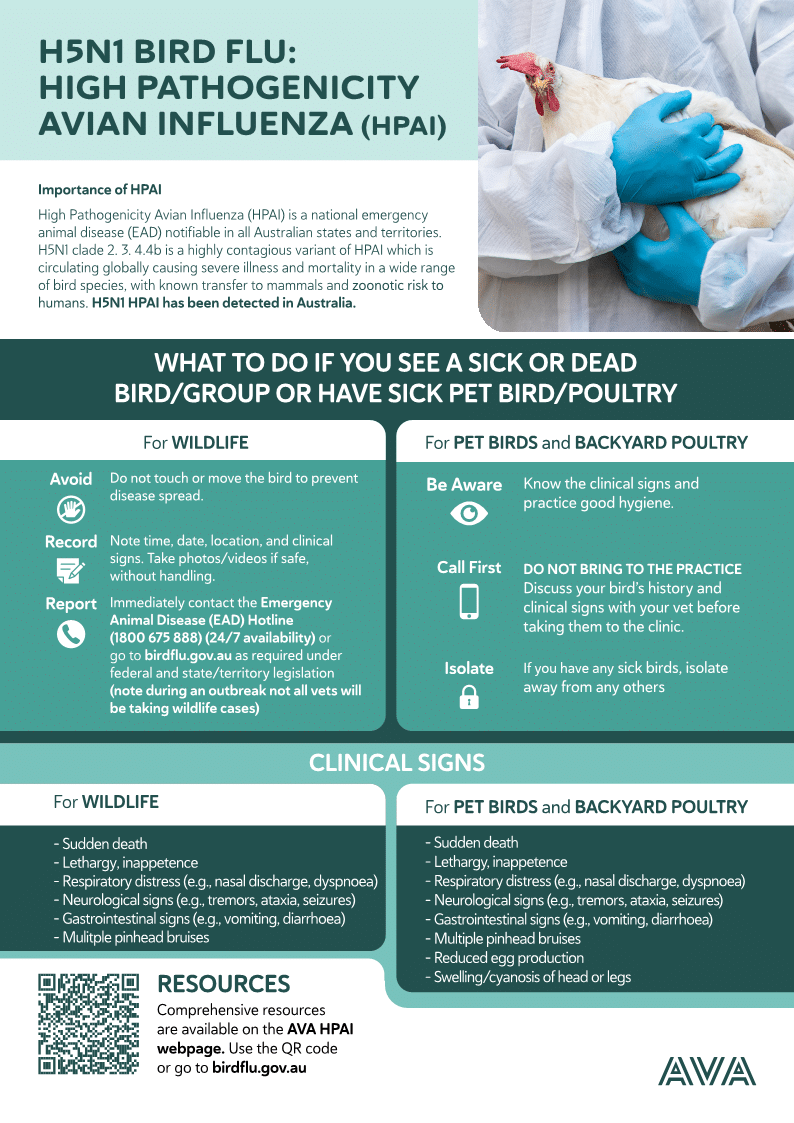
Avian influenza is a national notifiable emergency animal disease. Both vets and the public should Avoid. Record. Report. If you find a sick or dead bird or animal, don’t touch it, keep pets and children away, and from a safe distance take a photo and note the location. Report any unusual deaths to the Emergency Animal Disease Hotline on 1800 675 888, or via birdflu.gov.au.
The Department of Agriculture, Fisheries and Forestry have also published a catalogue of informative videos and other resources that provide easy to understand guidance on HPAI which can be accessed here.
For the latest national situation reports, see the DAFF H5 bird flu page and Wildlife Health Australia.
20 June 2026 – Member Update: Confirmation of H5 Avian Influenza in Western Australia
The Hon Julie Collins MP, Minister for Agriculture, Fisheries and Forestry confirmed the detection of H5 avian influenza in a brown skua found on WA’s south coast on 14 June. The bird was unwell, was isolated, and subsequently died. A second bird, a giant petrel, has also returned a positive result and will be subject to further testing to confirm the strain detected.
This is the first detection of the H5 strain on the Australian mainland.
Link to member update – https://www.ava.com.au/national/confirmation-of-h5-avian-influenza-in-western-australia