
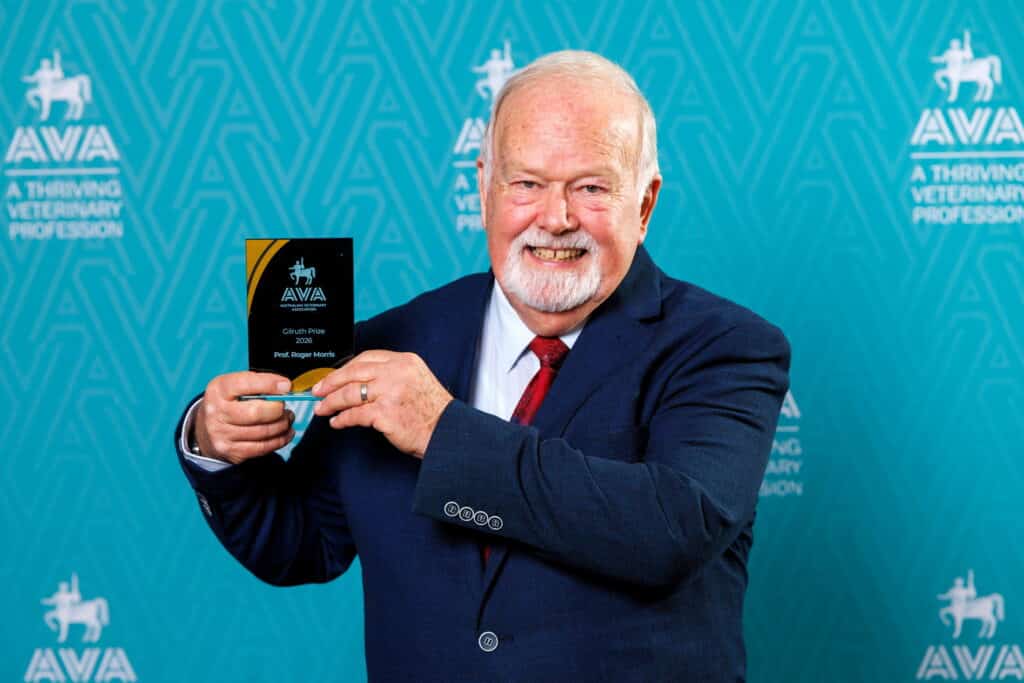
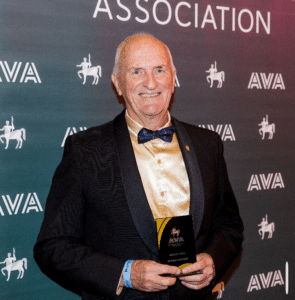
 2024 Winner- Gilruth Prize
Dr Peter Reid
Dr Peter Reid has dedicated his clinical career to the ongoing care and well-being of horses, with a particular focus on those in the racing industry. His expertise extends to the advancement of scientific research on emerging zoonotic viruses, an area where he has made significant contributions, especially in the field of equine health. A defining moment in Dr Reid’s career came in 1994, when he served as the attending clinician during a large-scale outbreak of the then-unknown Hendra virus in a thoroughbred racing stable in Brisbane, Queensland. This tragic event, which resulted in the death of 20 horses and one human, marked the beginning of Dr Reid’s long-standing involvement in researching zoonotic threats and their impact on both animal and human populations.
Since that pivotal moment, he has made contributions to the Australian Veterinary Association (AVA) and its members, as well as to Equine Veterinarians Australia (EVA) and other equine industry bodies. His work has also played a vital role in advancing scientific research into the study and prevention of zoonotic viruses. A key highlight of his career was being invited to deliver the prestigious Bethesda Keynote Lecture on Hendra virus at the United States Uniformed Services University in Maryland in 2023, a milestone that underscores his leadership in this important area of veterinary science. Throughout his career, Dr Reid has worked closely with a wide range of equine community organisations and scientific teams, aiming to mitigate the risks of emerging infectious diseases. His ongoing commitment to improving public and animal health continues to shape the future of veterinary science and practice.
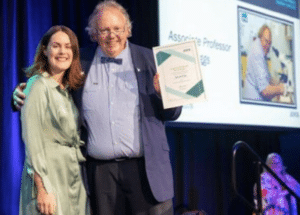 2023 Winner- Gilruth Prize
A/Professor David Beggs
David is dedicated to developing continuing education for veterinarians. He has been the Scientific Officer for the ACV since 2008 and convenor of ACV conferences and editor of the ACF journal and textbooks on pregnancy diagnosis and bull fertility. He was also convenor of the AVA Annual Conference for 4 years and the World Buiatrics Congress in 2014. David serves on the editorial board of the Journal of Dairy Science an reviewer board of Animals.
He has been an equivocal supervisor of 25 post-graduate veterinarians and teaches undergraduate veterinary students at University of Melbourne. He is held in high esteem as a mentor to many members of the profession. Contribution to veterinary literature include over 27 peer reviewed publications and over 25 veterinary conference presentations. David served on the Veterinary Practitioners Registration Board of Victoria for nearly a decade. He has utilised his information technology (IT) skills to improve veterinary practice with his first course for veterinarians in 1998 detailing how to use spreadsheets in farm consultancy. Since then he has developed dairy farm related software for Victorian veterinary practices as well as BioCheck®, Welfarecheck® and Bull Reporter® software for the ACV. David initiated and continues to moderate the “ACV List”, a closed email discussion list where ACV members can seek veterinary advice about issues concerning cattle.
David is well known for his major contributions to veterinary science in the field of animal welfare. He completed his PhD ‘Ensuring dairy cow welfare with increasing scale of production’ and represents the profession in multipe animal welfare fourms including the Victorian Animal Welfare Advisory Committee, DAFF Bobby Calf Solutions Tasforce, Dairy Moving Forward Animal Husbandry Group, Animark® Animal Welfare Standards Committee and Livecorpo Shipboard Animal Welfare Surveillance Committee.
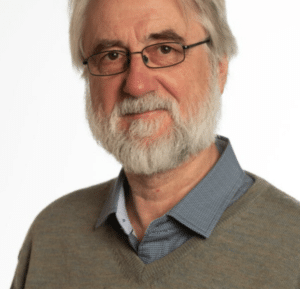 2022 Winner- Gilruth Prize
Dr Robin Gasser
Dr Robin Gasser is an inspiring and caring teacher, an exceptional veterinary researcher and an outstanding mentor. He has been a major contributor to veterinary science in Australia for over 30 years through his contributions to teaching and research in veterinary parasitology and is indisputably the most outstanding veterinary scientist in Australia. His research has generated deep knowledge and understanding of the biology of parasites, host-parasite interactions and diseases and this has underpinned his development of innovative methods for the diagnosis, treatment and control of socioeconomically important parasitic diseases.
The significance of his contributions is demonstrated by his election to the Australian Academy of Sciences in 2021 – only the second veterinary scientist to be recognized with this honour.
His research output of more than 680 papers in international peer-reviewed scientific journals is prodigious – much greater than any other veterinary researcher, and his work is exceptionally highly cited internationally. His commitment to international collaboration is exceptional. He has published with colleagues from more than 70 institutions from 25 different countries. His work is also marked by his commitment to the application of his fundamental research to achieve outcomes that benefit society, including through commercialisation, where possible.
He has been a major international contributor to the field of infectious diseases, particularly metazoan and protozoan parasites of major human and animal health importance. He has maintained a balance of fundamental and applied research. He has made a major contribution to the development and application of molecular technologies to investigate parasites (nematodes, cestodes, trematodes and protozoa) of socio-economic importance, including novel methods for the accurate identification and diagnosis of infections, and methods for the high resolution analysis of genetic variation in pathogens. His work has had implications in many areas, including the systematics, epidemiology, genetics and population biology, and diagnosis and control of wide variety of parasites of importance in animal health, public health and agricultural productivity.
The breadth and significance of Robin Gasser’s contributions to veterinary science make him a very appropriate recipient of the Gilruth Prize.
| Recipient | Year |
|---|---|
| Beggs, David | 2023 |
| Gasser, R | 2022 |
| Seksel, Kersti | 2021 |
| Axon, J | 2020 |
| Pollitt, Christopher | 2019 |
| Hampson, D | 2018 |
| Chenoweth, PJ | 2017 |
| Barton, MD | 2016 |
| Allan, Graeme | 2015 |
| Rickard, M | 2014 |
| Wishart, DS | 2013 |
| Nairn, M | 2012 |
| Whittem, JH | 2011 |
| Beveridge, I | 2010 |
| Lean, I | 2009 |
| English, A | 2008 |
| Entwistle, Keith William | 2007 |
| Whithear, KG | 2007 |
| Clarke, RE | 2005 |
| Murray, RW | 2004 |
| Rose, R | 2003 |
| Malmo, J | 2002 |
| Caple, Ivan | 2001 |
| Beveridge, WIB | 2000 |
| Alexander, GI | 1999 |
| Donald, Alan David | 1998 |
| Gee, RW | 1997 |
| Morley, FHW | 1996 |
| Rex, M | 1995 |
| Bryden, DI | 1994 |
| Howell, JM | 1993 |
| Edwards, MJ | 1992 |
| Jubb, KVB | 1991 |
| Hughes, KL | 1990 |
| Dun, RB | 1989 |
| Snowdon, WA | 1988 |
| Arundel, JH | 1987 |
| Pascoe, RR | 1986 |
| Flynn, DM | 1985 |
| Francis, J | 1984 |
| Blood, DC | 1983 |
| McDonald, IW | 1982 |
| Webster Snr, AF | 1981 |
| Fethers, GF | 1980 |
| Sutherland, AK | 1979 |
| Watts, RM | 1978 |
| Stewart, DF | 1977 |
| Miller, SJ | 1976 |
| Kesteven, KVL | 1975 |
| Oxer, DT | 1974 |
| Meldrum, GK | 1973 |
| Cole, VG | 1972 |
| Hungerford, TG | 1971 |
| Pullar, EM | 1970 |
| Webster, W | 1969 |
| Murnane, D | 1968 |
| Edgar, G | 1967 |
| Gregory, TS | 1966 |
| Gordon, H McL | 1965 |
| Gill, DA | 1962 |
| Rose, AL | 1961 |
| Albiston, HE | 1959 |
| Turner, AW | 1958 |
| Bennetts, HW | 1957 |
| Legg, J | 1956 |
| Bull, LB | 1955 |
| Seddon, HR | 1954 |
| Henry, M | 1953 |
| Stewart, JD | 1953 |