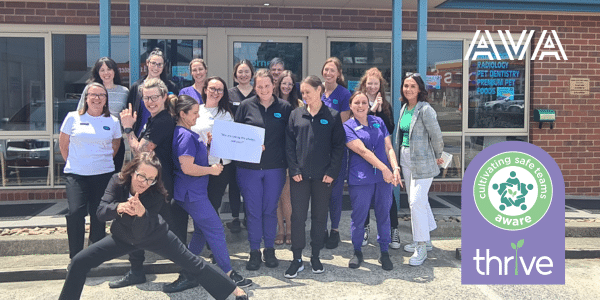
The mental health and wellbeing of the veterinary workforce is increasingly recognised as a shared opportunity to strengthen workplaces and the profession. This positive shift is reflected in the final report from the 2025 South Australian Parliamentary Inquiry into Veterinary Mental Health and Wellbeing, which highlighted the value of industry-led initiatives that build leadership capability and workplace culture, such as AVA’s Cultivating Safe Teams program. The Inquiry’s recommendations strongly encourage proactive, practical approaches to evaluating work culture, supporting leadership capability and reducing psychosocial risk.
South Australian practice owner Dr Alan Dalgarno, who contributed to the Inquiry and is now training to deliver AVA’s Cultivating Safe Teams – Aware program, believes this focus is both necessary and overdue.
“I’m really passionate about the veterinary industry, and I think it has the potential to be such a wonderful career in life. But I know currently the industry faces headwinds, and mental health challenges are a significant obstacle to having a really fulfilling career for a lot of vets.”
Why leadership and culture matter
Psychosocial risks – such as excessive job demands, bullying, poor support, lack of role clarity and low recognition – are increasingly recognised as being just as important as physical safety risks. Left unmanaged, they contribute to stress, burnout, absenteeism and workforce attrition.
For Dr Dalgarno, contributing to the Inquiry reflected a long-standing responsibility to the profession. “As a vet for more than 30 years, and a practice owner for over 20 years, I felt I had a perspective and a lived experience that was important. I felt that I had a responsibility to take some action.”
He was also mindful of avoiding solutions that could unintentionally place further strain on already stretched practices, noting he wanted to “increase the chances that the Inquiry went down a really positive pathway,” rather than introduce measures that be counterproductive and add more pressure on small businesses.
From awareness to action: Cultivating Safe Teams
AVA’s Cultivating Safe Teams Aware program aligns strongly with the Inquiry’s emphasis on evaluation, leadership and culture. Delivered through AVA Thrive, the program supports veterinary teams to track psychosocial risks and take achievable steps to prevent harm. It does this through a one-hour training program that builds foundational understanding of psychosocial safety and helps demystify work health and safety obligations in a way that feels accessible rather than overwhelming.
This is where education becomes a critical enabler – helping teams move from uncertainty to action. As Dr Dalgarno explains, “a psychologically safe practice is everybody’s responsibility – and everybody can contribute to a thriving practice. There are a lot of well‑intentioned people who are totally daunted by psychological safety and WHS requirements. A little bit of education is often all that’s needed to get the ball rolling.”
For practice owners unsure whether engaging in this work is worth the investment, Dr Dalgarno points to one common and positive result. “You might be surprised by the level of engagement from your team when you invite them to help you build a thriving practice.” He also highlights that addressing psychosocial risk offers both protection and opportunity, adding “At a minimum, this process can protect you from litigation – but at its best, it drives engagement and helps create a genuinely thriving workplace.”
Insights gathered through Cultivating Safe Teams – Aware sessions show a consistent pattern emerging across veterinary teams. The top three psychosocial hazards identified are:
- High job demands
- Lack of reward and recognition
- Poor workplace relationships
These findings closely mirror the evidence presented to the South Australian Parliamentary Inquiry and reflect the everyday experience of many veterinary professionals. Importantly, they highlight that psychosocial risk in veterinary practice is rarely about individual resilience alone. Instead, it reflects how work is designed, supported and experienced collectively.
By explicitly framing psychosocial safety as a shared responsibility, Cultivating Safe Teams – Aware creates a space for teams to have constructive, non‑blaming conversations. Rather than asking “who is struggling?” teams are supported to ask, “how is our work currently structured, and what could we redesign together?”
This collaborative approach allows teams to begin addressing workload pressures, improving communication, strengthening recognition and feedback, and rebuilding relationships – in ways that are practical, inclusive and sustainable.
Access support, resources and career coaching
Alongside Cultivating Safe Teams, AVA members and their teams can access a range of confidential support, education and wellbeing resources through AVA’s Employee Assistance Program, Converge. This month’s resources align directly with the top three psychosocial hazards identified through CST Aware.
- How to deal with workplace stress – practical guidance on recognising stress and responding to sustained high demands
- Why a healthy workforce is good for business – exploring the link between psychosocial safety, recognition and sustainable performance
- Preventing workplace bullying – recognising, addressing and preventing harmful behaviours early
- You can find these articles in
April’s Flourish Health & Wellbeing Magazine
- – latest edition or you can listen to this podcast:
How Does Organisational Culture Support Your Wellbeing
AVA members and their teams can access the EAP for career coaching. To find out more about using coaching for growth to help strengthen reward, recognition and engagement, register for these free webinars:
Together, these resources support teams to move from identifying psychosocial hazards to collaboratively redesigning work, strengthening relationships and improving how work is experienced day‑to‑day.
Getting involved with Cultivating Safe Teams
Practices interested in hosting a Cultivating Safe Teams AWARE session in their clinic can register their interest here.
A shared responsibility, a stronger profession
The South Australian Parliamentary Inquiry made clear that improving veterinary mental health requires both individual support and systemic change. Programs like Cultivating Safe Teams, alongside accessible member resources, provide a practical, collaborative way forward.
As Dr Dalgarno reflects: “A thriving workplace is a profitable thing to do – and it’s the morally right thing to do. We all care about each other, so let’s work together to build thriving businesses.”