
Policies

The AVA’s policies and position statements are among the most significant contributions the Association makes to the veterinary profession and to animal welfare in Australia. Grounded in scientific evidence and shaped by the collective expertise of AVA members, they represent the profession’s authoritative voice on the issues that matter most.

Every submission to all levels of government, public consultation, sponsorship, education initiative, and media statement AVA makes is underpinned by a robust, evidence-based policy framework. These policies do not sit on a shelf. They are actively used across all aspects of the Association to uphold the highest professional standards and protect the reputation of the AVA as an organisation firmly grounded in evidence-based science. When policymakers, regulators, industry stakeholders, or the wider community need a trusted veterinary perspective, they turn to AVA.

Policies are developed by AVA members and address the key issues that members feel strongly about in the profession. The Policy Advisory Council (PAC) facilitates and maintains this member-driven policy development. As a broad and representative body, the PAC comprises policy councillors from each of AVA’s 19 Special Interest Groups, eight Division representatives, and the nine AVA Board Directors. Working groups are convened to research, draft, and refine each policy, drawing on targeted reviews of the scientific literature and multiple rounds of member consultation. Every effort is made to ensure content is comprehensive, balanced, and free from bias. The result is a policy position that reflects the genuine consensus of the profession. The diagram below illustrates the annual policy development cycle, from the formation of new working groups through to Board ratification.
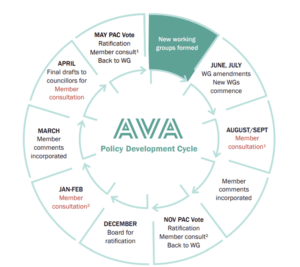
In 2025 alone, 23 working groups were active. Sixteen policies were progressed to Board ratification and a further seven reached the member consultation stage. The Policy Team also contributed to nationally significant work including the AUSVETPLAN Destruction Manual, the National Animal Welfare Standards and Guidelines and development of National H5 HPAI guidelines for veterinarians, reinforcing AVA’s standing as the trusted veterinary voice for government.

There are several ways AVA members can contribute to policy development throughout the year.
  • Through your Special Interest Group or Division. Each SIG and Division has a PAC councillor who represents member views directly in the policy development process. Engaging with your SIG or Division is one of the most direct ways to influence the profession’s policy agenda.
  • Through member consultation. Policies under development are opened for broader member comment at key stage of the development cycle. All members are invited to review draft policies and submit feedback directly via the AVA Member Hub (Circle). This is the easiest way to stay across what is currently open for input and make your voice heard, regardless of your level of involvement in a SIG or Division.

Member input is invaluable; your voluntary contributions help influence every policy and give the AVA’s positions their creditability and authority. We encourage all members to engage, whether by commenting on policies that matter to you or by taking a more active role through your SIG or Division. Your voice counts.

Membership of AVA means more than access to these policies. It means the opportunity to shape them. Member consultation is built into every stage of the development cycle. Your expertise, your clinical experience and your professional perspective directly impact the positions AVA takes on behalf of the entire profession. The more members engage, the stronger and more representative that voice becomes.

These policies span scientific, technical, ethical, and philosophical areas. They serve a practical purpose in daily professional life, providing evidence-based guidance on clinical, ethical, and regulatory questions across every area of veterinary practice. Notably, 85% of policies are developed in response to issues that the profession cares deeply about, while 15% provide important technical guidance.

Browse the full library of policies and position statements organised by topic area

Animal welfare

The AVA is committed to the highest standards of animal welfare across all species and contexts. Our policies and position statements reflect the profession’s ethical obligations and provide evidence-based guidance for veterinarians, policymakers and the broader community. Policies cover topics including: 

  • Animal welfare principles and philosophy
  • Euthanasia
  • Events and exhibits involving animals
  • Export of live animals
  • Hunting and fishing
  • Research and teaching — use of animals

Use of Veterinary medicines, AMR

The responsible use of veterinary medicines is essential to animal health, public safety and the global effort to combat antimicrobial resistance. These policies guide veterinarians on prescribing practices, compounding, immunobiologicals and the safe handling of hazardous substances. Topics covered include:

  • Use of antimicrobial drugs and antimicrobial resistance
  • Prescription animal remedies
  • Veterinary immunobiologicals
  • Veterinary prescribing rights
  • Compounded pharmaceuticals
  • Cytotoxic drug safety

Veterinary profession policies

The veterinary profession operates at the intersection of clinical practice, public health, regulation and community trust. The AVA’s policies in this area support veterinarians and Allied professionals to practise ethically, sustainably and to the highest professional standard. Topics covered include:

  • Workplace wellness and sustainability
  • Regulation of veterinarians and paraprofessionals
  • Biosecurity and public health
  • Complementary and alternative treatments
  • Identification of animals
  • Professional practices for veterinarians
  • Surgical, medical and other veterinary procedures

Companion animals

Companion animals are central to the lives of millions of Australians and their care represents a significant part of veterinary practice. The AVA’s policies in this area cover the full spectrum of companion animal health, behaviour, welfare and the commercial activities that affect them. Topics covered include:

  • Behaviour
  • Commercial activities
  • Health
  • Management and welfare

Livestock

Livestock production intersects animal welfare, public health, environmental sustainability and economic necessity. The AVA’s livestock policies provide veterinarians and industry with evidence-based guidance across all major production species. Topics covered include:

  • Cattle health and welfare
  • Deer health and welfare
  • Horse health and welfare
  • Pig health and welfare
  • Poultry health and welfare
  • Sheep and goat health and welfare
  • Livestock — general

Unusual pets and Avian

The keeping of unusual pets and avian species presents distinct veterinary and welfare challenges. These policies provide guidance on the health, husbandry and ethical considerations associated with non-traditional companion animals, from rabbits and reptiles to native species and backyard poultry. Topics covered include:

  • Dentistry in non-traditional companion animals
  • Feeding practices for reptiles and small mammals
  • Vaccination of rabbits and ferrets
  • Native animals as pets
  • Sale of unweaned altricial birds
  • High pathogenicity avian influenza in pet birds and backyard poultry

Wild animals

Wild animals require protection that recognises their ecological role, sentience and the complex interactions between human activity and natural systems. These policies address vertebrate pest control, the management of feral animals and the welfare of native and introduced species across Australian landscapes. Topics covered include:

  • Vertebrate control programs and non-target animal welfare
  • Control of feral horses and other equidae
  • Control of native and introduced animals causing damage to agriculture or habitat
  • Farming of native fauna
  • Kangaroo and wallaby population control

Environment and conservation

Veterinarians have a responsibility to engage with the environmental challenges that affect animal health and welfare at a population level. These policies address climate change, drought, habitat clearing, biodiversity and the sustainability of veterinary and animal production practices in the context of a changing natural world. Topics covered include:

  • Climate change and animal health, welfare and production
  • Drought and drought management
  • Native animal welfare and habitat clearing
  • Sustainability in animal production and veterinary practice

Have your say on AVA policy

The Member Hub (Circle) is AVA’s online member community, and it is where policies under development are posted for member comment. During consultation periods, draft policies are shared in Circle so members can read, discuss and submit feedback directly, helping shape the final position of the profession.
Access to Circle is included as part of your AVA membership.

To get started:

  1. Sign up at the AVA Circle community using the same email address you registered with for your AVA membership
  2. Once logged in, navigate to the Policies for Member Comment space 
  3. Look for posts tagged Policies for member comment to see what is currently open for input
  4. Read the draft policy and add your comment directly on the post

Not yet a member? Join the AVA to access Circle and have your say in shaping the policies that represent your profession.