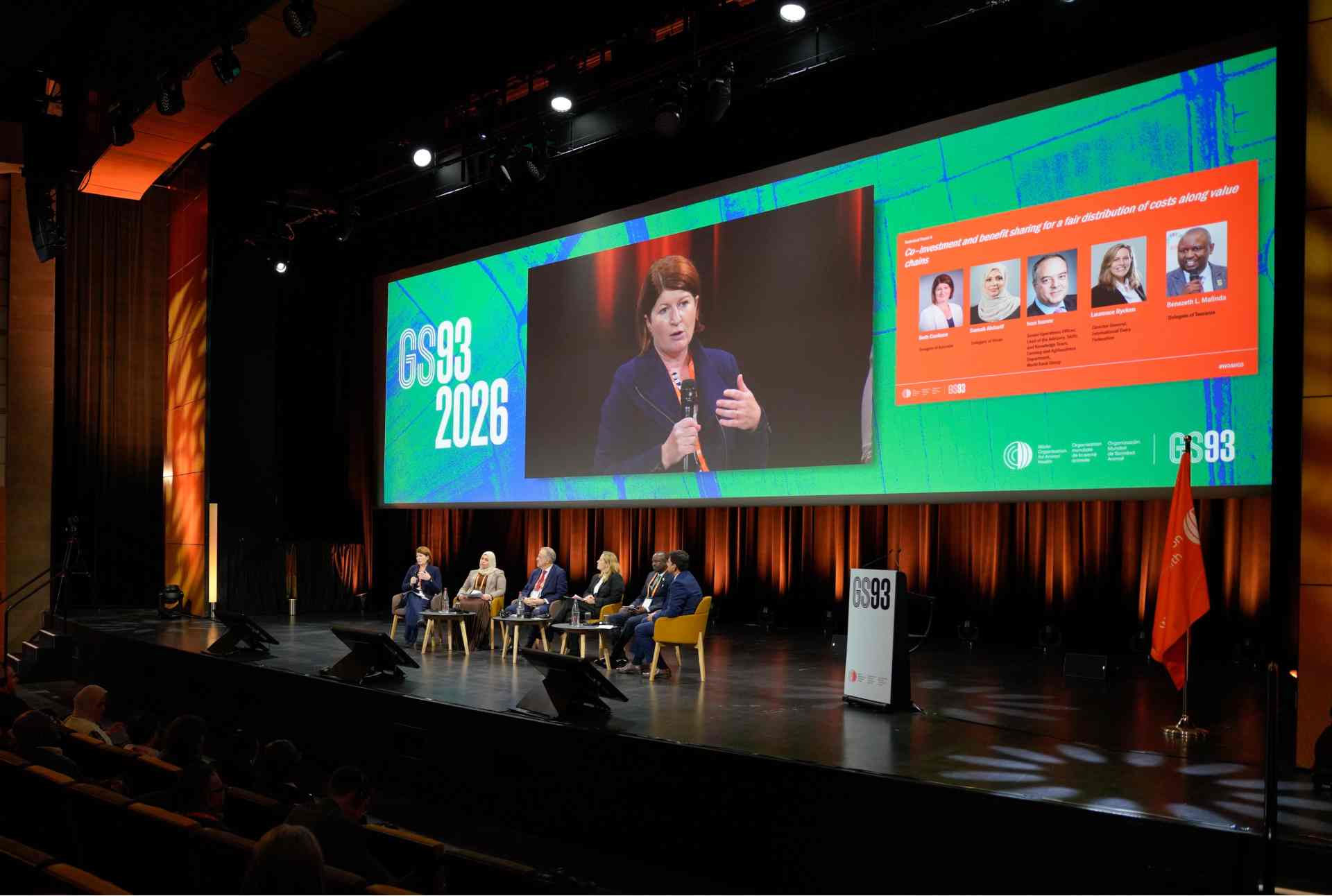
You may recall from my past updates at this time of year, that animal health leaders converge in Paris every May for the World Organisation for Animal Health (WOAH) General Session of the World Assembly of Delegates. This annual meeting provides an opportunity for WOAH’s 183 Members to address priority global animal health matters and deliberate on international standards for animal health and welfare.
This year saw the 93rd General Session attended by over 1300 attendees from across 130 Members from 18–22 May at a new venue. As Australia’s Delegate to WOAH, I was honoured to lead our 10-member delegation which included colleagues from the Department of Agriculture, Fisheries and Forestry, together with fellow animal health leaders from jurisdictional governments, the Australian Centre for Animal Disease Preparedness, Wildlife Health Australia, and industry.
Investing in Animal Health
The theme of this year’s Animal Health Forum, which kicks off each General Session, was ‘Investing in Animal Health to Protect Everyone’s Future’. A theme which resonates amongst animal health professionals, the forum brought together governments, non-profits, intergovernmental organisations, and the private sector to consider global resource allocation and the benefits for investing in animal health and welfare activities. The message was clear: while the impacts may disproportionately affect low- and middle-income countries, failure to invest in animal health is at all our peril; and the cost of inaction exceeds the cost of prevention. A key statistic reflected in the discussion was that despite mounting disease crises and escalating risks to food systems, economies and public health worldwide, the animal health sector receives as little as 0.6% of global health spending.
Throughout my career, promoting investment in animal health has been critical, as has working together with partners to achieve positive animal health outcomes. These principles apply whether working clinically with an individual animal or herd, through to policy leadership at national and global levels.
I was honoured to be asked to participate as a panelist during a session dedicated to ‘co-investment and benefit sharing for a fair distribution of costs along value chains’. I took this opportunity to highlight the achievement of the Australian Brucellosis and Tuberculosis Eradication Campaign and how the success of this program shaped Australia’s animal biosecurity system, including through enduring public-private partnerships.
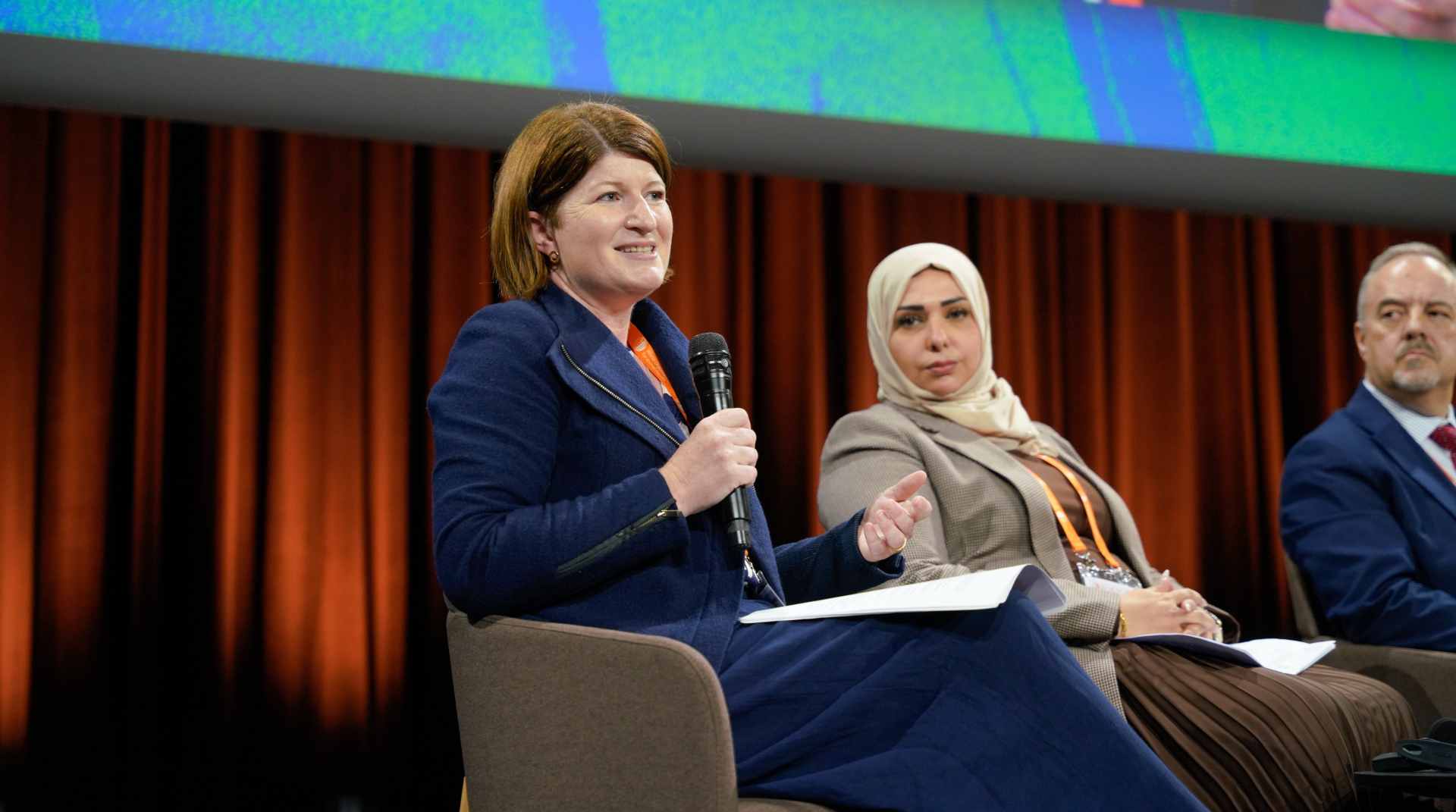
Sharing insights about Australia’s disease response arrangements during the Animal Health Forum panel discussion
A resolution associated with the forum was adopted at the end of the week providing recommendations to both WOAH and its Members to generate sustained investments in animal health systems, through a mix of public and private financing, in recognition that animal health is fundamental to food security, public and environmental health, economic development, shared prosperity, biodiversity, and global health security. Resolutions adopted at the General Session can be found on the WOAH website for the event.
Standards and Resolutions
One of the ways that Australia continues to invest in and influence global animal health outcomes is through active participation in WOAH’s standard setting processes and sharing our technical expertise.
WOAH is the international standard setting body for animal health and zoonoses under the World Trade Organization Sanitary and Phytosanitary Agreement. Standards undergo a thorough consultation process by Members and subject matter experts before they are ultimately presented for adoption by the Assembly at the General Session. Long before standards make it to General Session, my office leads consultation across Australia to actively shape them, working closely with governments, industries, and other stakeholders through biannual consultation periods to ensure standards are science-based and do not create unjustified burden. This year, 51 international standards were adopted across WOAH’s terrestrial and aquatic animal health codes and manuals. Notable standards included those on animal welfare during slaughter, terrestrial animal biosecurity, and historical freedom provisions for the salmon parasite Gyrodactylus salaris.
In addition to standards, Members were asked to consider resolutions on other technical and administrative matters – making it a very full and productive General Session. One such resolution that was unanimously adopted was for WOAH’s 8th Strategic Plan for 2027-2031. This plan offers new strategic direction with a focus on strengthening international standards and transparent disease reporting, empowering animal health systems, and elevating the importance of animal health globally. All common themes addressed across the week.
Governance Review Committee
The Assembly also adopted a resolution supporting the future work program of WOAH’s Governance Review Committee (GRC) of which I am a nominated member from the region of Asia and the Pacific, alongside representatives from China and Sri Lanka. The GRC began its work in 2025, to strengthen and modernise the institutional, technical and financial governance of WOAH and to update the organisation’s legal framework. A series of recommendations from the GRC were endorsed by the General Assembly, including to commence a consultation process with all Members on changes to the organisation’s model for membership fees to improve financial sustainability. The committee’s work has now been extended to May 2028.
Animal Health Quadrilateral Alliance
In addition to being able to represent our region in work such as the GRC, I am also proud of our collaborations with those from other regions. This includes working with my counterparts from Canada, New Zealand, the United Kingdom, and the United States and their teams as this year’s Chair of our Animal Health Quadrilateral Alliance (Quads Alliance). The Quads Alliance is led by the Chief Veterinary Officers of these countries and works collaboratively to address emerging and ongoing issues related to animal health and welfare to support a safe and strong, rules-based approach to international trade in animals and animal products. A key focus of the work of the Quads Alliance is engaging with and providing coordinated and strategic influence at WOAH, and this year’s General Session was no exception. As influential Members advocating across the regions of the Americas, Europe, and Asia and the Pacific, we met with WOAH’s organisational and technical organ leaders, coordinated voting positions on international standards and actively shaped the final resolutions adopted by the General Assembly.
During proceedings, I delivered joint Quads Alliance interventions supporting WOAH’s 8th Strategic Plan, adoption of the Global Action Plan for Antimicrobial Resistance, and supporting WOAH’s work on development of standards for Emergency Management.
Bilateral Meetings
With so many animal health leaders under one roof, the General Session offers a unique opportunity to meet with other Members. Australia formally met with 21 other delegations to discuss shared biosecurity interests and address technical market access matters. Productive conversations were also had with other parties in attendance including the International Federation for Equestrian Sports, in preparation for Australia hosting the 2032 Olympic Games. Many informal engagements during the week proved useful in developing working relationships with Members and animal health professionals, some of whom Australia has limited opportunity to directly engage with outside of this unique environment.
Looking Ahead
Global investment in animal health is not a new topic; and it is undoubtedly an issue that will continue to require leadership from WOAH, its Members, and beyond. As Australia’s Minister for Agriculture, Fisheries and Forestry, Julie Collins MP, stated in a virtual message shared during the opening ceremony, “Investment in animal health not only benefits our animals but is directly linked to our food security, our national economy, our biosecurity and our trading relationships. That’s why our continued investment along with our ongoing collaboration is critical for citizens and our neighbours.”
Though no one country can address this alone, Australia continues to play an important role globally and regionally, remaining a committed member of WOAH and advocating for animal health, science-based international standards and transparent reporting of animal disease events.
Likewise, reflecting the discussions during the recent General Session, this is not solely the domain of the public or private sectors; and likewise, cannot rely solely for those directly involved in animal health. We rely on partnerships and advocates across and outside the animal health sector, and a common understanding of how we all stand to benefit from positive animal health outcomes.
And on the topic of partnerships and collaboration, while I feel privileged to represent Australia abroad, I don’t do this in isolation. I would like to thank all of those who provided their time and knowledge preparing for this important week in the animal health calendar and supporting animal health outcomes in Australia and beyond. I would especially like to thank the members of the Australian delegation and my office who provided their expertise across the week. I encourage you to learn more about WOAH and opportunities to be involved in future. Please consider reaching out to my office (WOAHAustralia@aff.gov.au) to receive information when WOAH international standards are open for comment and sharing your expertise. We all stand to benefit.
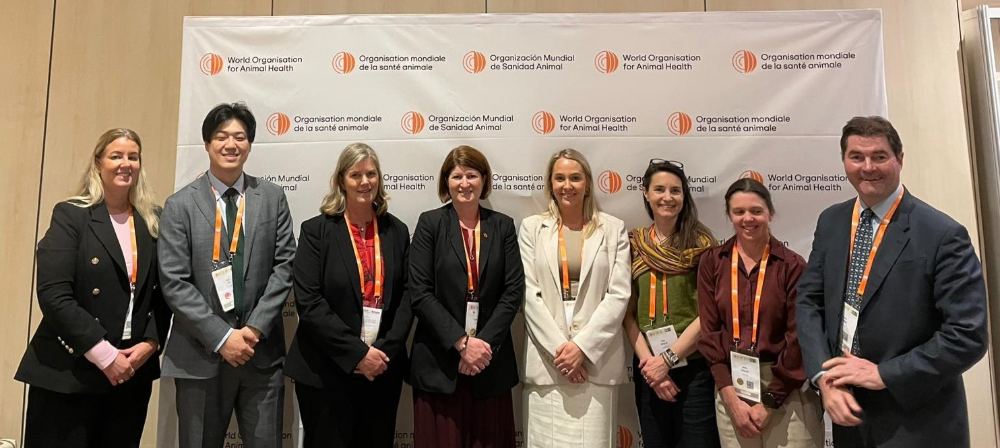
The Australian Delegation to the WOAH 93rd General Session. Left to right: Amy Little (Agriculture Counsellor, London), Gary He (Senior Veterinary Officer, DAFF), Rochelle Prattley (Acting Assistant Secretary, DAFF), Beth Cookson (Australian Chief Veterinary Officer, DAFF), Katie Hallatt (Executive Committee Member, Animal Health Industry Forum), Tiggy Grillo (Chief Operating Officer, Wildlife Health Australia), Debbie Eagles (Director, Australian Centre for Disease Preparedness), Graeme Cooke (Victorian Chief Veterinary Officer). Not pictured: Ashley Jordan (Senior Principal Veterinary Officer, DAFF), Deborah McSweyn (Acting Tasmanian Chief Veterinary Officer)