Ratification date: 16/07/2026
Purpose
To provide an overarching statement on animal welfare that can be used:
- as the basis for development of further animal welfare related policies and AVA strategy
- as the basis of advocacy on behalf of the AVA, including public statements and submissions
- for educational purposes.
Policy
- Animals have intrinsic value and are sentient beings who are conscious, able to feel pain, and experience emotions. Therefore, all animals1must be treated humanely and with respect, with a view to meeting their individual and species-specific welfare needs.
- Where humans own, use, care for, or interact with animals, there is a duty of care to safeguard, monitor and maximise the animals’ welfare, allowing them to experience ‘a good life’.
- Ethical frameworks and principles should be used to underpin decisions and policymaking on animal welfare issues.
- State and territory animal welfare legislation must be harmonized across Australia, including consistent: legal definitions of ‘animal’, recognition of animal sentience, duty of care provisions, and enforceable standards which protect animals’ physical and mental wellbeing.
- An independent animal welfare office or commission should be established to oversee national animal welfare policy and standards development and facilitate implementation across jurisdictions.
- Veterinarians are leaders in animal welfare science and policy; they must continue to play an important role in safeguarding and promoting good animal welfare and advocating for improved animal welfare outcomes.
- Animal welfare, including the Five Domains Model, must be a core component of formal education and training programs for veterinarians, animal carers and handlers.
- Effective community education should be in place to enhance understanding and promote appropriate animal care, and to foster respect and consideration for all animals.
- There should be continuing in-principle and financial support for animal welfare-focused research and development.
- One Welfare principles should be adopted by, and reflected throughout, animal welfare, human wellbeing and environmental sustainability policies. Urgent action is required to further understand and minimise the negative impacts of climate change on the health and welfare of animals.
- The AVA is committed to engaging and supporting veterinarians to advocate for policies, laws, practices, research and education which improve animal welfare outcomes.
Background
1. What is animal welfare?
Sentience
Sentience is the capacity to have subjectively positive and negative mental or emotional experiences; thus, the welfare of sentient animal’s matters. Animals who are known to be sentient include all vertebrates, and some classes of invertebrates (e.g. cephalopods and crustacea) (Broom 2007). Ongoing research is likely to lead to inclusion of additional groups within this definition.
Animal welfare
Animal welfare is an animal’s overall subjective experience of their life. It can be considered over timeframes ranging from one moment to a lifetime. It covers both physical and mental state and can be negative, neutral or positive. Physical state includes health, vigour, and functional capacity; whilst mental state includes emotions associated with physical state and the nature of interactions with the environment, other animals and people. These include negative mental states such as fear, pain, nausea, thirst, hunger, and anxiety, whilst positive emotions include feelings of joy, contentment, satiation, anticipation, optimism, rigour and a sense of freedom to express self-motivated behaviours.
A ‘good life’
Ensuring animals have good welfare goes beyond preventing or minimising negative experiences. A ‘good life’ is one in which an animal’s positive experiences far outweigh any negative experiences (McMillan 2005; Mellor 2016). Self-motivated behaviours and goals vary between species and individual animals, and both are important to achieve optimal welfare. Animals must be given the choice, opportunity and capacity to fulfil self-motivated goals such as seeking shade or shelter, nesting, foraging, socialising, participating in play, or exploratory behaviours (Littlewood et al 2023). To this end, welfare standards should include mandatory enrichment and socialisation protocols that optimise the psychological health of the animals involved.
As well as ensuring the opportunity for animals to live a good life, every effort must also be made to ensure a humane death for animals. A humane death is when an animal is either killed instantly, or rendered insensible until death ensues, without pain, suffering or distress. Animals may die in varied circumstances. These include slaughter for food, euthanasia due to severe illness, injury, or financial constraints; culling for population or disease control purposes, in emergency animal disease responses, in natural disasters, or to avoid negative welfare outcomes. Where this is within human control, every effort must be made to minimise or avoid pain, distress or suffering prior to death. Veterinarians play a key role in providing advice and expertise to achieve a humane death for animals in a range of situations. (see Policies Humane slaughter; Euthanasia of injured wildlife; Euthanasia)
Assessing animal welfare – the Five Domains
A useful framework for considering and assessing animal welfare is the internationally recognised Five Domains Model (the Model) (Mellor & Reid 1994; Mellor, 2017). The Model has a strong focus on how animals feel (mental state) which has expanded our thinking and consideration beyond the physical aspects relating to animal welfare (Mellor & Beausoleil, 2015).
The Model comprises five key components – 1. Nutrition; 2. Physical Environment; 3. Health; 4. Behavioural Interactions with the environment, other animals; and humans; 5. Mental state (Mellor et al 2020).
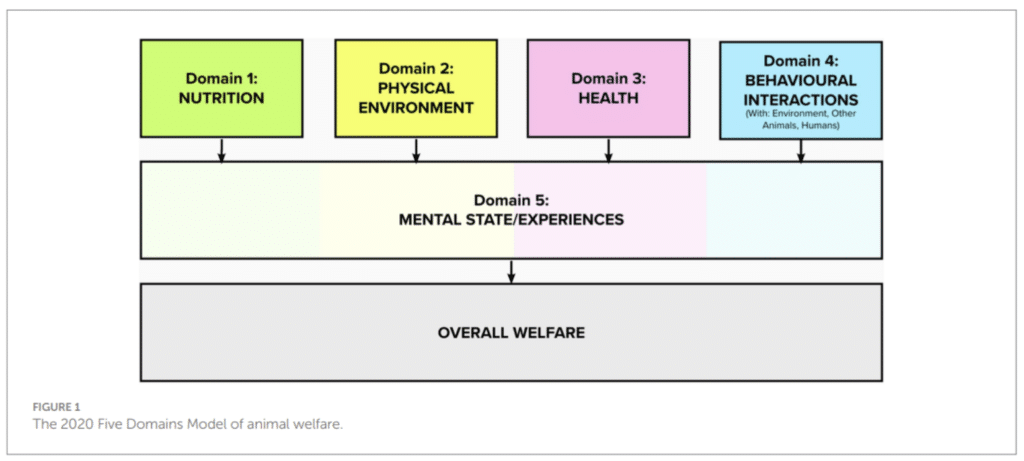
From Littlewood et al 2023
There are a number of other internationally well-regarded models for assessing animal welfare including The Welfare Quality Framework®, Fraser’s 3 Circles, Marian Dawkins Model (Blokhuis et al, 2010; Fraser 2008; Dawkins 2021).
2. Animal Ethics
Animal ethics is a branch of ethics which examines human-animal relationships, the moral consideration of animals and how animals should be treated. Ethical treatment of animals encompasses compassion, a reverence for life and nature, and taking responsibility to minimise harm, particularly when human needs may conflict with animal well-being. Thus, ethical considerations that respect animals’ inherent value and wellbeing are essential when making decisions about animal welfare (Rollin 2015). The AVA Statement of principles – animal welfare and ethics provides further detail.
3. The role of veterinarians in animal welfare
As highly trained professionals with expertise in animal physiology, behaviour, health and care, veterinarians have an important role and responsibility to educate and advocate for improved animal welfare outcomes in all species. Through their expertise and everyday work, veterinarians are expected by the community to be strong advocates for animals in all situations where they may be impacted by humans.
The roles of veterinarians in animal welfare include:
- preventing and treating disease and illness in animals.
- preventing and/or alleviating pain and suffering.
- monitoring, assessing, and advocating for animal welfare and wellbeing.
- advocating for legal reform, and engagement in the implementation of these reforms.
- educating industry and the community by promoting good animal welfare practices and calling out animal cruelty.
- acting as expert witnesses in animal cruelty prosecutions.
- promoting optimal welfare in research and teaching activities which involve animals, including as members of animal ethics committees.
- to engage in research to improve the understanding of animal welfare and implement this into practice.
- to engage in the development and implementation of animal welfare standards and assessment protocols and certification schemes.
Additionally, there are a number of avenues for veterinarians to gain further skills in animal welfare science and the legal and ethical aspects of animal welfare; these include gaining Membership or Fellowship of the Australian and New Zealand College of Veterinary Scientists (ANZCVS), international qualifications and research higher education degrees.
4. Animal welfare laws and regulations in Australia
Responsibility for animal welfare legislation
The Australian Constitution has no head of power for animal welfare so animal welfare legislation in Australia is the responsibility of States and Territories. It comprises Animal Welfare Acts and Regulations which are predominantly administered by Departments of Agriculture or Primary Industries, except in the ACT. Enforcement of animal welfare laws is mainly undertaken by these departments along with authorised animal welfare agencies such as the RSPCA or Animal Welfare League, although authorised officers can be designated in other government agencies (including police and local government) and in some industries (e.g. horse and greyhound racing) in most jurisdictions.
There may be competing priorities for Departments of Agriculture/Primary Industries tasked with both promoting industry productivity and regulating animal welfare. The AVA has long championed the need for national animal welfare oversight by an impartial body, to ensure separation between agriculture policy matters and farm animal welfare monitoring and enforcement functions, in line with the 2016 Australian Government Productivity Commission recommendations (Productivity Commission, 2016).
Lack of national consistency
Although there are many similarities in animal welfare legislation across jurisdictions, there is an urgent need for consistency and harmonisation, including:
- recognition of animal sentience.
- definition of “animal” to include fish and other marine species.
- consistent inclusion of “duty of care” provisions to help ensure good welfare is achieved in a proactive sense (i.e. placing an onus on animal carers to provide for the animal’s good health, ability to express self-motivated behaviours and positive interactions with other animals, people and the environment), rather than Acts only having the power to respond to cruelty after the fact (i.e. neglect, abuse, ill-treatment, recklessness, abandonment etc.) which is the focus of the older Acts; and
- recognition of the impacts of human actions on an animal’s mental state (in addition to its physical state).
Compliance and enforcement
It is important that there are appropriate mechanisms for effective compliance monitoring and enforcement through educational and deterrent responses. Animal welfare codes of practice/standards should be consistently mandated under regulations in all jurisdictions. Systems for animal welfare regulation should engender certainty that breaches will be detected and acted upon.
Co-regulation
While legislation is largely focused on punitive ways to achieve compliance, there can be benefits in positively incentivising organisational and individual behaviours to advance animal welfare through accreditation or quality assurance schemes based on regular independent audits against higher animal welfare standards, Product labelling based on animal welfare standards, and underpinned by a credentialled program, can help provide transparency and empower consumers in their purchasing decisions; this may in turn help to drive positive change (e.g. cessation of cosmetic testing using animals). However, it is acknowledged that challenges still exist, and new approaches should be considered (Ingenbleek 2022).
5. Animal welfare education, training and research
Animal welfare must be central to training, education, and information provided to all those who interact with animals, including as a key focus of undergraduate and post graduate veterinary training. Such education must ensure that welfare is understood as more than just physical health and extends to the full spectrum of the Five Domains Model and the principles of promoting a ‘good life’ for animals. This allows individuals to understand and prioritise the physical and mental wellbeing of animals in their care, grounded in evidence-based science, ethics, and legal responsibilities.
The field of animal welfare science has expanded significantly over the past 40 years and continues to grow. Ongoing research, which is scientifically sound, ethically conducted and aims to achieve significant improvements in animals’ lives, is essential.
6. What is ‘One Welfare’?
‘One Welfare’ is a concept that recognises the interconnections between animal welfare, human wellbeing, and the environment and emphasises the essential role of the veterinarian and interdisciplinary collaboration and solutions (Stephens, 2021). This considers mental health as well as physical health and is thus an extension of the ‘One Health’ concept. There are many examples including:
- Climate change, where human activity can significantly impact the environment, which in turn impacts animal welfare (Lacetera 2019). For more information read the AVA policy: Climate change and animal health, welfare and production.
- Domestic violence, where family members including pets are subjected to cruel treatment (Tiplady et al 2017)
- Animal hoarding, where an individual may suffer mental illness resulting in acquiring too many animals who cannot be cared for appropriately (Lockwood 2018).
For more information on One Welfare see AVA policy on Animal welfare and human wellbeing – vulnerability of clients and veterinary staff, and Enhancing veterinary care through veterinary social services position statement.
Recommendations
How can we improve the lives of animals in Australia?
National animal welfare coordination and oversight
The establishment of a National Animal Welfare Commission that has clear independence from political and commercial interests would provide an opportunity to coordinate and harmonise all state and territory animal welfare legislation and standards and their enforcement.
Robust animal welfare standards development
Animal welfare standards should be science-based wherever possible, provided science is assessed in a robust manner and quality evidence is used; where science is lacking the precautionary principle should apply and first principles (first do no harm) must be employed in favour of animals’ best interests.
Australia should aspire to lead the world in animal welfare standards and practices. In line with this, the government should ensure that Australia is not importing animal-derived products from countries with lower animal welfare standards.
Animal welfare labelling standards should be developed and implemented for animal-based products to allow consumers to make informed choices.
Adequate resourcing of animal welfare monitoring and enforcement
Animal welfare regulatory bodies (government departments and delegated agencies) should be better resourced to undertake compliance and enforcement activities in states and territories. This should also include improvements in public reporting and transparency around compliance outcomes. Currently, most enforcement is dependent on complaints, as agencies do not have capacity to proactively monitor or audit against standards.
Sufficient funding for proactive animal welfare monitoring programs should also be available to allow earlier interventions to prevent poor outcomes. The existence of welfare monitoring programs would lead to better transparency and improve community confidence, strengthening Social Licence to Operate through demonstration of compliance with higher welfare standards (Hampton et al 2020).
Related AVA policies
References
Blokhuis HJ, Veissier I, Miele M, & Jones B. (2010). The Welfare Quality® project and beyond: Safeguarding farm animal well-being. Acta Agriculturae Scandinavica, Section A, 60(sup1), 129–140.
Broom DM (2007) Cognitive ability and sentience: Which aquatic animals should be protected? Dis Aq Org, 75:99-108.
Dawkins MS (2021). The Science of Animal Welfare: Understanding What Animals Want. Oxford University Press.
Fraser D (2008). Understanding Animal Welfare: The Science in Its Cultural Context. Wiley-Blackwell.
Hampton JO, Jones B, McGreevy PD (2020) Social licence and animal welfare: Developments from the past decade in Australia. Animals 10, 12, 2237.
Ingenbleek PTM, Krampe C (2022) The end of animal welfare labelling as we know it? Persisting problems at the consumer level and PLF-based solutions. Front Anim Sci, 3:819893. https://10.3389/fanim.2022.819893
Lacetera N (2019) Impact of climate change on animal health and welfare. An Front, 9:26–31. https://10.1093/af/vfy030
Littlewood KE, Heslop MV, Cobb ML (2023) The agency domain and behavioural interactions: assessing positive animal welfare using the Five Domains Model. Front. Vet Sci,10. https://doi.org/10.3389/fvets.2023.1284869
Lockwood R (2018) Animal hoarding: The challenge for mental health, law enforcement, and animal welfare professionals. Behav Sci Law, 36(4). https://10.1002/bsl.2373
McMillan FD (2005) The concept of quality of life in animals. In: Mental health and wellbeing in animals. 1stEdition:183-200. Edited by FD McMillan Blackwell Publishing, Iowa.
Mellor DJ (2016). Updating Animal Welfare Thinking: Moving beyond the “Five Freedoms” towards “A Life Worth Living”. Animals. 6(3):21. https://doi.org/10.3390/ani6030021
Mellor DJ (2017) Operational details of the Five Domains Models and its key applications to the assessment and management of animal welfare. Animals 7(8):60. https://10.3390/ani7080060
Mellor DJ & Reid CSW (1994) Concepts of animal well-being and predicting the impact of procedures on experimental animals. In Improving the Well-Being of Animals in the Research Environment; Australian and New Zealand Council for the Care of Animals in Research and Teaching (ANZCCART): Glen Osmond, SA, Australia, pp. 3–18.
Mellor DJ & Beausoleil NJ (2015) Extending the ‘Five Domains’ model for animal welfare assessment to incorporate positive welfare states. An Welf 24:241–253. https://10.7120/09627286.24.3.241
Mellor DJ, Beausoleil NJ, Littlewood KE et al (2020) The 2020 Five Domains Model: Including Human-Animal Interactions in Assessments of Animal Welfare. Animals 10(10):1870. https://10.3390/ani10101870
Productivity Commission 2016, Regulation of Australian Agriculture, Report no. 79, Canberra: https://www.pc.gov.au/inquiries/completed/agriculture/report/agriculture.pdf
Rollin B (2015) The inseparability of science and ethics in animal welfare. J Ag Env Ethics 28:759-765.
Tiplady C, Walsh DB, Philips CJC (2017) “The Animals are All I Have” Society & Animals https://doi-org.ezproxy1.library.usyd.edu.au/10.1163/15685306-12341464