
State Reports have been provided by NSW, VIC, SA and WA representatives providing an overview of the recent months and months ahead. They are below:
NSW – Matt Pope
Autumn and early winter were dominated by ongoing drought conditions across much of New South Wales. Limited pasture availability and declining ground cover saw many producers adopt a cautious approach, with a strong focus on managing stocking rates and securing feed supplies ahead of winter. Memories of the last major drought, combined with the high cost of supplementary feeding and more recently the increasing cost of freight, saw many producers favour destocking over feeding.
Our practice experienced an increase in earlier-than-usual pregnancy testing, with producers keen to identify non-pregnant females and make timely marketing decisions. In many cases, strong cattle prices and the need to reduce stocking pressure resulted in mobs being sold without pregnancy testing.
Winter has commenced warmer than average across many districts. More recently, widespread rainfall has provided a welcome change and a stark contrast to the conditions experienced through autumn. While spring is still some way off, the rainfall has significantly improved producer confidence and outlook.
Attention is now shifting towards bull breeding soundness evaluations as we move into the peak bull testing period ahead of upcoming sales and the spring joining season. At the other end of the reproductive cycle calvings have only been sporadic so far – we haven’t even got our ‘Calving Wars’ tally sheet up yet. One of my colleagues, who has managed to get and correct two uterine torsions using the plank technique, is keen to work out what bonus points apply to this.
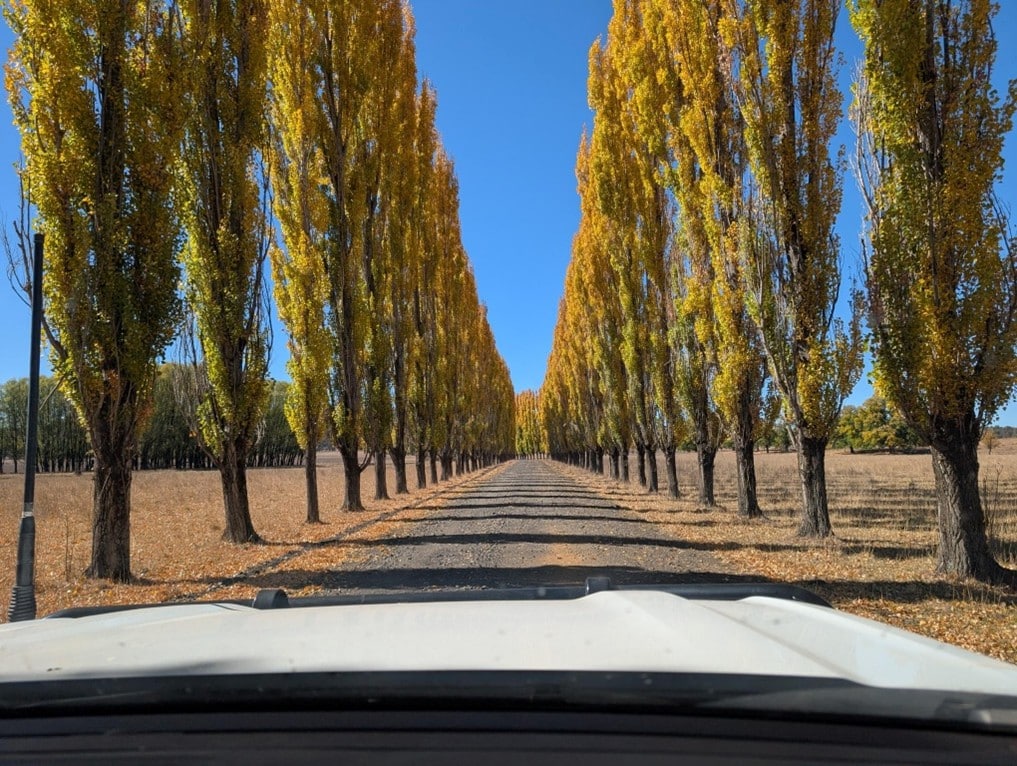
The accompanying photograph was taken while travelling to a pregnancy testing appointment and captures the conditions experienced across many areas of NSW during autumn. In this case, there were more fallen leaves beneath the poplar-lined driveway than grass, highlighting the severity of feed shortages prior to the recent rainfall.
Victoria – James Tamone
Safe to say things are very much back on track in Victoria, or at least here in the South-West. Even through the rainfall we have seen in the first half of the year is still below the annual average – if you talk to the producers, they’d say it is shaping up to be one of the best seasons on record. Realistically it is probably closer to an average season, but on the back of the nightmare two years of severe drought, it’s clear we are celebrating having grass again here in the South. Warm days through to May have meant freshly sown pastures (and whole farms) are well established and setting up producers with a glut of feed in time for the cold winter months. Cows are overall in very good condition as calving commences here and seems so far to be proceeding without issue.
The good news doesn’t stop there; markets have remained extremely strong. Beef prices have remained high while lamb prices have soared to record prices with a recent sale in Ballarat topping $500/head for heavy export lambs. Unfortunately, the same cannot be said for the opening milk prices which fell a little short of hopes of breaking $10/kgMS floor price.
The rain of course does bring issues of its own as lame cow numbers have sky rocketed. Understandably track maintenance has been low on the priority list for most over the past few years as we faced more pressing issues and now we are paying the price. Guess we better sharpen up the hoof knives and tune up the angle grinders as I feel it’s going to be a long and busy lame cow season.
South Australia – Sean McGrath
The 2026 Autumn couldn’t have been more different in SA compared with the last two. Early rains have been backed up with continued good falls, leading to above average rainfall for the last couple months and plenty of excess feed available. Supplementary feeding has been minimal, which is a welcome change for producers.
Poor seasonal conditions in Northern NSW and associated depressed prices for a short time has seen plenty of cattle move South to the state, with producers taking the opportunity to restock or make use of the surplus feed with cheap cattle. A few cases of transit associated BRD were the experience of some clients, resulting in some significant mortality and morbidity events.
The early green conditions have lead to some disease investigations, mainly for ill thrift. In our area this has uncovered the usual suspects of worms and trace element deficiency, which whilst exacerbated by the unusual conditions, it is still surprising to see producers miss important preventative treatments for these omnipresent conditions. Grass tetany has also been an occasional problem, once again the green conditions catching some out, especially after not having to worry about the disease for a couple years.
On a regulatory front, the new Veterinary Services Act has deemed that veterinary business premises be regulated. Whilst it may not be too onerous for most practices nor change much, it does add another layer of administration to veterinary businesses in the State. These changes will take place over the coming months, with premises and a responsible person for them required to be registered with the board. Until next time, let’s hope the commodity pundits are right and beef prices continue to climb.
Western Australia – Jess Shilling
I’d like to start this report by providing an apology to members for the absence of a state rep update last quarter. In March, we welcomed our daughter “Maggie” into the world, so things were a little busier than normal! I’m glad to report that Cody (dad) has proved to be the perfect heifer’s bull with low birthweight (2.79kg) and good calving ease (fast delivery, no calving chains required). Maggie is settling in well and somehow manages to sleep her way through hours of banging and crashing in the cattle yards better than she does in the quiet of her own cot.
Now, on to business…! 2026 appears to be rapidly disappearing, somehow the year is already halfway over. Our southern WA vets are swapping out their calving gowns for AI sleeves as the Autumn calving season tapers off and the mating season takes a full swing. Our northern colleagues are still dealing with the aftermath of cyclone Narelle, which hit the state in late March/early April. Rainfall has been below average across most of the state for the recent period, with the exception of the far north Kimberly region. The long-term forecast for June to August is looking to be warmer and drier than median, thanks to an El Niño, a positive Indian Ocean Dipole and developing high-pressure systems.
The WA Veterinary Practice Act reforms continue to roll out, with the 2025 amendment regulations now in effect and their practical implications becoming clearer across the profession. Much of the focus has centred on the more detailed definition of “acts of veterinary medicine,” alongside updated frameworks for delegation and supervision of veterinary nurses and other trained personnel. Changes relating to pregnancy testing and spaying of cattle have been a particular point of discussion, with regard to new pathways for non-veterinarians to provide these services. Increased requirements around CPD, clinical record keeping, prescribing, and practice standards are also now in place, signalling a broader shift toward a more structured and compliance-focused regulatory environment. As many practises adjust to these changes, further clarification and refinement are likely as the legislation settles.
Also, on the legislative front are changes to the WA firearms Act, which have now been in place for over 12 months. These changes have aimed to increase firearm control and safety. As with any new legislation, there are potential unintended consequences. In this case, there are some unclarities around the licencing of firearms being used by veterinarians to euthanise livestock. The AVA WA branch has been working on this throughout the year, with Dr David Marshall attending a public consultation and providing a professional opinion on how veterinarians and animal welfare are being impacted by the recent changes.
Like the rest of the country, fuel security and input costs have emerged as key concerns across the state in early 2026. The WA Government’s move to establish a strategic diesel reserve highlights broader unease around supply chain reliability, with flow-on implications for transport, mustering, and overall cost of production. Fertiliser availability and pricing pressures are also being closely watched in mixed farming regions, contributing to a general tightening of margins across the board.
One comfort to ease the increasing input costs is the increase in the cattle market in recent weeks. Market conditions are strong relative to the eastern states, with the WYCI currently sitting at ~925c/kg cwt compared to the EYCI at ~866c/kg cwt (although both are up ~30% on this time last year). Export markets remain critically important, and there is ongoing industry sensitivity around policy settings that may impact live export and broader market access. While the current focus has been on the live sheep trade phase-out, there is continued awareness of the potential for future scrutiny of live cattle exports and the implications this would carry for northern systems in particular.
WA members – if there are topics or issues you would like highlighted in future updates, please feel free to get in touch: jess.shilling@bovitech.com.au
Thanks for reading—here’s to a legen-dairy month ahead!